What Makes Seamless Patterns with Pastries So Irresistible in Digital Design
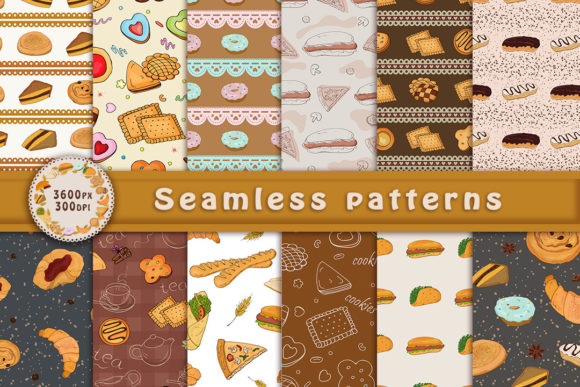
There is something deeply comforting about a croissant rendered in pixel-perfect detail, repeated endlessly across a phone case or a bolt of fabric. Seamless patterns with pastries have carved out a significant niche in surface design, blending nostalgia, warmth, and a touch of whimsy into repeatable visual systems. These patterns do not simply show baked goods. They capture textures, flaky layers, golden crusts, and powdered sugar dustings in arrangements that flow without interruption from edge to edge.
Designers working in textiles, stationery, packaging, and digital products have embraced pastry motifs with surprising enthusiasm. The appeal cuts across age groups and markets. A child's bedding set covered in smiling croissants performs well, but so does a sophisticated tote bag featuring meticulously illustrated danishes in muted, earthy tones. The versatility of the subject matter drives a lot of this demand. Seamless patterns with pastries can read as playful, elegant, rustic, or minimalist depending entirely on execution.
Why Pastries Work So Well as Pattern Elements
Pastries carry cultural weight. A croissant signals French café culture. A cinnamon roll evokes Scandinavian hygge. A mooncake anchors itself in East Asian tradition. When these forms get translated into repeating patterns, they bring narrative depth that abstract geometric shapes simply cannot match. People form emotional connections with food imagery, and pastries sit at the intersection of indulgence, celebration, and daily ritual.
The shapes themselves lend beautifully to pattern construction. Consider the natural geometry at play. A round donut creates a perfect circle with a contrasting center hole. A triangular samosa or turnover introduces diagonal energy. Long, rectangular mille-feuille slices offer horizontal grounding. When a designer arranges seamless patterns with pastries, these varied silhouettes interact in ways that feel organic even though the repetition is mathematically precise.
Texture as a Differentiator
Flat vector illustrations have their place, but many successful pastry patterns lean heavily into texture. A croissant without visible lamination looks like a crescent-shaped blob. Seamless patterns with pastries thrive when the designer captures flakiness, glaze sheen, crumb structure, or the rough sparkle of coarse sugar. This attention to surface quality separates amateur pattern work from professional-grade output that brands are willing to license.
Digital tools now allow remarkably nuanced texture work. Procreate brushes that mimic dry pastels or watercolor washes can give pastry illustrations a hand-rendered feel. Adobe Illustrator's grain effects and opacity masks let vector artwork retain scalability while suggesting tactile surfaces. The pattern remains cleanly repeatable, but each pastry element carries visual weight and believability.
Building a Functional Repeat System
A seamless pattern, by definition, tiles infinitely without visible seams. Achieving this with irregular, organic subjects like pastries requires careful planning. Unlike geometric repeats where elements lock together like puzzle pieces, seamless patterns with pastries demand a different approach to distribution and overlap.
Designers typically work within a square or rectangular bounding box. Elements that cross the top edge must reappear at the exact corresponding position on the bottom edge. The same holds true for left and right boundaries. With pastry motifs, this means a croissant half-exiting the right side needs its other half entering from the left at precisely the same vertical coordinate. Most pattern design software handles this automatically through offset tools, but the visual rhythm still requires human judgment.
Density and Breathing Room
One critical variable is density. A tightly packed pattern with pastries almost touching creates an immersive, maximalist effect perfect for bold apparel or statement wallpaper. The same motifs spread further apart with generous negative space produce something calmer, suitable for notebook covers or kitchen textiles. Seamless patterns with pastries benefit from testing at multiple scales because what works as a throw pillow design might overwhelm when applied to a duvet cover.
Consider the end-use substrate as well. Patterns destined for woven fabric behave differently than those printed on smooth paper. Thread count, weave texture, and ink absorption all interact with the visual appearance of pastry details. Experienced surface designers keep these production variables in mind from the earliest sketching phase.
Color Palettes That Complement Baked Imagery
Color selection dramatically shifts the mood of seamless patterns with pastries. Warm, golden-brown tones with cream backgrounds reinforce the actual appearance of baked goods and appeal strongly to bakery brands and food packaging clients. But designers regularly push past literal color expectations.
Pastel colorways with lavender croissants and mint-green danishes have found enthusiastic audiences in stationery and baby products. Monochromatic palettes using varying saturations of a single hue can make pastry patterns feel sophisticated and editorial. Dark backgrounds with richly saturated pastries in jewel tones create dramatic, almost baroque effects suited for evening wear or luxury paper goods. The subject matter handles this chromatic flexibility surprisingly well because the recognizable silhouettes anchor the imagery even when colors depart from reality.
Seasonal and Limited-Edition Applications
Pastry patterns adapt beautifully to seasonal collections. Autumn versions might feature pumpkin pastries, maple-glazed donuts, and spice-toned backgrounds. Winter holiday iterations could spotlight gingerbread, stollen, and panettone. Spring patterns gravitate toward fruit tarts, floral-decorated cookies, and lighter, airier compositions. This seasonal flexibility makes seamless patterns with pastries commercially valuable for brands that release periodic collections and need fresh surface designs on predictable schedules.
Industry Applications and Commercial Reach
The market for these patterns extends well beyond fabric shops and scrapbooking supplies. Food and beverage brands license seamless patterns with pastries for packaging design, café interior elements, employee uniforms, and promotional merchandise. A coffee chain might wrap its seasonal cups in a repeating pattern of illustrated biscotti and madeleines. A bakery subscription box can use coordinated pattern systems across its website, tissue paper, and sticker sheets.
Home décor represents another substantial segment. Kitchen towels, oven mitts, aprons, tablecloths, and ceramicware all serve as canvases for repeating pastry motifs. The association between pastries and domestic warmth makes these products feel natural rather than novelty-driven. Consumers buy a tea towel printed with repeating cinnamon rolls because it genuinely enhances their kitchen aesthetic, not merely as a whimsical impulse purchase.
Digital Products and Virtual Goods
An emerging market exists in digital spaces. Website backgrounds, social media templates, phone wallpapers, and digital planner stickers all incorporate seamless patterns with pastries. Content creators in food niches use these designs to maintain visual consistency across platforms. Pattern marketplaces like Creative Market, Spoonflower, and Etsy teem with pastry-themed digital downloads, and the most successful offerings typically combine high-quality illustration with genuinely seamless repeat engineering.
Common Pitfalls When Designing Pastry Patterns
Novice designers often gravitate toward subjects they love, and many begin their pattern design journey with food motifs. Seamless patterns with pastries can suffer from several recurring issues worth anticipating.
Recognizability at small scale presents the first challenge. A beautifully detailed croissant illustration might read clearly at full size but become an indistinct golden blur when reduced to a one-inch repeat. Designers address this by simplifying internal details, strengthening silhouettes, and testing patterns at their intended output dimensions before finalizing.
Repetition fatigue surfaces when a pattern lacks sufficient variety in its elements. A design featuring only one croissant illustration, rotated and mirrored across the repeat, can feel mechanical and deaden the organic warmth that attracts people to pastry imagery in the first place. Successful seamless patterns with pastries typically include three to five distinct pastry illustrations with variations in rotation, scale, and positioning. Some designers introduce supporting elements like crumbs, berries, coffee beans, or flourishes to create secondary visual rhythms within the repeat.
Scale sensitivity causes problems when patterns designed on large desktop monitors get uploaded to print-on-demand platforms without considering real-world dimensions. A pattern that tiles elegantly at screen size might reveal awkward gaps or unintentional clusters when enlarged to fabric width. Testing at multiple scales, including physical print samples, prevents expensive disappointments.
Tools and Workflows for Building Pastry Repeats
Adobe Illustrator remains a dominant tool for vector-based pattern creation. Its Pattern Options panel handles offset calculations automatically while allowing real-time preview of the repeating result. Designers can draw pastry elements directly in Illustrator or import raster textures refined in Procreate or Photoshop. The blend of vector precision and incorporated texture gives seamless patterns with pastries both technical cleanliness and sensory appeal.
Procreate's pattern design capabilities have expanded significantly. Artists sketch and paint individual pastry elements on separate layers, then arrange them within a designated repeat template. The app's Drawing Assist and transform tools enable offset positioning, though true seamless verification often requires export and testing in secondary software. Many designers develop a hybrid workflow where illustration happens in Procreate and repeat assembly occurs in Illustrator or Affinity Designer.
For those working exclusively with raster textures, Photoshop's Offset filter paired with the Clone Stamp tool provides a manual but highly controllable method of building seamless repeats. This approach particularly suits seamless patterns with pastries rendered in watercolor, gouache, or heavily textured digital brushes where preserving an organic, handcrafted quality matters more than vector scalability.
Licensing, Trends, and Market Positioning
Surface pattern designers selling seamless patterns with pastries benefit from understanding where demand currently concentrates. Kitchen and dining textiles maintain steady baseline interest. Children's products cycle through food themes regularly. The café and bakery industries provide consistent commercial clients. Trending aesthetics like cottagecore, grandmacore, and dark academia all have room for pastry motifs executed in appropriately aligned visual languages.
Licensing arrangements vary widely. Some designers sell exclusive pattern rights to individual brands for premium fees. Others distribute non-exclusive digital files through marketplaces, earning smaller per-sale amounts but building cumulative passive income. Portfolio-building matters enormously since art directors evaluating potential licensees look for evidence that a designer can produce cohesive collections, not just isolated attractive repeats. A strong pastry pattern collection might include coordinating designs at different scales, companion blender patterns, and color-varied versions suited to distinct seasonal or demographic markets.
Getting Started with Your Own Pastry Pattern
Begin with observation. Photograph actual pastries under soft natural light. Study the way butter layers separate in a croissant's cross-section, how glaze pools in a donut's crevices, or how powdered sugar settles unevenly across a danish's surface. These details inform illustration decisions later.
Sketch multiple pastry subjects before committing to a pattern direction. A series of individual illustrations developed with consistent lighting and stylistic choices will integrate more convincingly into a repeat than a single pastry copied and rotated. Think about the negative space relationships between elements as carefully as the elements themselves. The gaps between illustrated pastries create their own shapes, and intentional management of these secondary forms distinguishes polished patterns from amateur ones.
Test early and test often. Print your work-in-progress pattern at its likely final dimensions and view it from typical usage distances. A pattern intended for wallpaper needs evaluation from across a room. A pattern destined for a phone case requires up-close scrutiny. Adjust element sizes, spacing, and color contrast based on these real-world observations.
The technical requirements of seamless repeating patterns can feel intimidating at first, but the underlying principles become intuitive with practice. Start with simple two-element repeats, master the offset mechanics, and gradually introduce more complex arrangements and additional pastry varieties. Over time, you will develop an eye for the rhythmic balance that makes seamless patterns with pastries feel effortless even though they rest on careful construction.
Whether you design for fabric collections, digital download shops, brand collaborations, or personal creative satisfaction, pastry patterns offer a subject matter that connects with people on a surprisingly deep level. Food imagery triggers memory, comfort, and desire in ways that purely decorative motifs rarely achieve. When that emotional resonance gets combined with technically flawless repeat engineering, the resulting designs find enthusiastic audiences across diverse markets and applications.