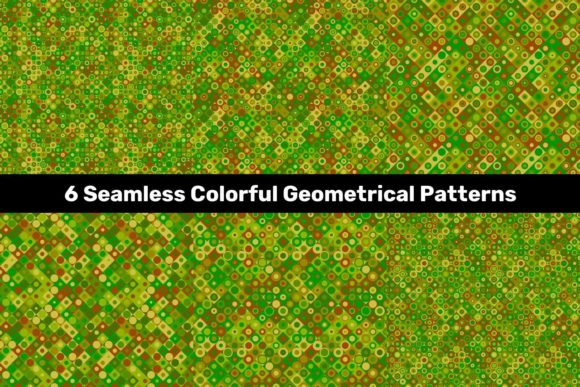
Exploring 6 Seamless Geometrical Circle Patterns That Elevate Visual Communication
What Makes a Circular Pattern Truly Seamless?
A seamless geometrical pattern is one that repeats across a surface without visible breaks, creating a continuous, flowing visual experience. When circles form the core geometry, the challenge becomes maintaining that uninterrupted rhythm—each curve must align perfectly, leaving no awkward gaps or abrupt edges. Unlike straight-edged polygons, circles require precise tangential relationships or consistent overlap to achieve seamlessness. The mathematical elegance of these arrangements has fascinated artists, architects, and data visualizers for centuries. The 6 seamless geometrical circle patterns discussed here represent distinct approaches, each with unique structural and aesthetic properties that make them relevant across industries from textile design to user interface prototyping.
At their heart, these patterns exploit symmetry, rotation, and translation. A truly seamless circular motif can be tiled in any direction and still feel intentional. This quality is what separates a casual doodle from a production-ready design asset. Whether you’re crafting a phone wallpaper, a ceramic tile mosaic, or a dynamic web background, understanding the underlying geometry unlocks a new level of control and creativity.
Pattern One: Concentric Ring Tessellations
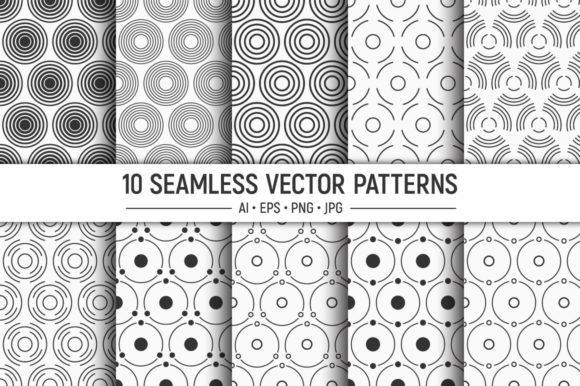
Concentric ring tessellations build on the idea of nested circles that repeat at regular intervals. When placed in a grid, the rings overlap or align to form a mesmerizing illusion of endless depth. The most straightforward version places identical concentric circles in a square lattice, where outer rings just touch. Slight adjustments to the spacing can create optical interference patterns, often seen in lenticular printing or moiré effects. These 6 seamless geometrical circle patterns include this fundamental yet powerful layout because of its versatility: you can vary ring thickness, color gradients, or even introduce radial lines to simulate reticles, targets, or sound wave visualizations.
Designers frequently use concentric tessellations for backgrounds that need a subtle technological feel—think dashboards, audio visualizer skins, or event stage projections. The seamless quality ensures that no matter the screen size, the pattern remains cohesive. In physical products, laminates and gift wrap paper often adopt this motif, as it adds a modern, ordered energy without overwhelming the viewer.
Pattern Two: The Flower of Life Overlay
One of the most recognizable 6 seamless geometrical circle patterns is the Flower of Life, formed by equally spaced overlapping circles arranged in a hexagonal symmetry. When extended across a plane, each circle’s center lies on the circumference of surrounding circles, producing a repeating lattice of six-petaled flower-like intersections. This ancient symbol appears in sacred geometry, but its seamless tiling capabilities make it a staple in contemporary mandala art, laser-cut screens, and even circuit board decorative elements.
What makes the Flower of Life so compelling is the secondary shapes that emerge—lens-like intersections, hexagons, and hidden curves that a simple glance might miss. Advanced pattern makers often extract a single repeat tile that captures these relationships perfectly, enabling endless scrolling backdrops for meditation apps, wellness brand packaging, or ethics-forward fashion brands seeking a timeless, cross-cultural appeal. Its seamless nature also lends itself to large-scale architectural facades, where etched glass or perforated metal panels follow the pattern without obvious joins.
Pattern Three: Tangential Circle Grids with Curvilinear Negative Space
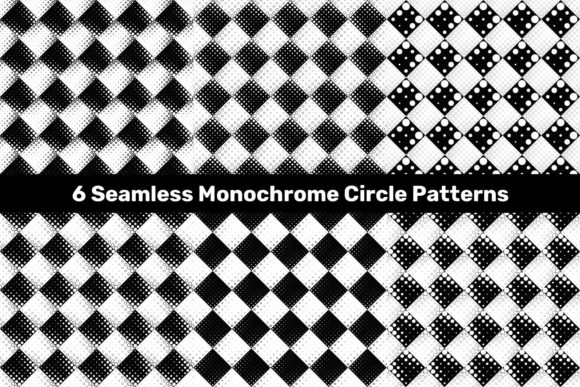
In a tangential circle grid, equal-sized circles are spaced so that each one touches its neighbors at exactly one point. When arranged in a square or triangular lattice, the negative space between the circles forms curved, diamond-like or triangular voids. These voids become the focal point of the pattern, offering a dramatic interplay between positive and negative shapes. Among the 6 seamless geometrical circle patterns, this one excels in high-contrast applications—think Islamic geometric windows, modern shower curtain designs, or abstract corporate logos where the eye travels fluidly between black and white.
The key to seamlessness here is the alignment of center points along multiple axes. Even slight misalignments will create disruptive lines when the pattern repeats. Professionals often use vector software with snap-to-grid precision to guarantee that each tile boundary meets the same tangent condition. The result is a crisp, rhythmic lattice that feels both mathematical and organic, suitable for environments ranging from minimalist hotel lobbies to medical device enclosures seeking a clean, precision-oriented aesthetic.
Pattern Four: Interlocking Circle Chains
Interlocking circle chains borrow from the familiar imagery of links, rings, or Olympic symbols. By intersecting circles in a linear or staggered sequence, you create a continuous flow that suggests connection, unity, and networks. Seamless versions of this pattern ensure that the chain motif wraps around without end—perfect for ribbon-like headers on websites, woven textile bands, or three-dimensional modeling of molecular structures.
This pattern often leverages alternating colors and stroke weights to emphasize depth; one common technique treats overlapping regions as transparent, mimicking the look of chainmail or advanced armor patterns in gaming assets. Because circles must intersect with precise overlap percentages to maintain uniformity, designers often rely on scripting or parametric tools to generate thousands of variations quickly. The resulting seamless file can be applied to anything from athletic wear with compression zones to Ethereum-inspired generative art collections, where each piece explores a unique colorway while honoring the underlying circular geometry.
Pattern Five: Spiral Circle Arrays
Spiral circle arrays arrange circles along an exponential or Fibonacci spiral, creating a dynamic, swirling progression that radiates outward. When carefully tiled, this seemingly chaotic layout becomes an orderly, seamless surface—each circle’s position is dictated by a golden ratio increment, and the entire pattern can be wrapped so that opposing edges match. Among the 6 seamless geometrical circle patterns, the spiral array is the most organic, often evoking the unfurling of fern fronds, galactic structures, or the arrangement of seeds in a sunflower head.
To achieve seamlessness, the spiral must either be limited to a tileable segment or the algorithm must incorporate wrap-around logic. The resulting designs are favorites in the fashion industry for hypnotic leggings and scarves, as well as in motion graphics where the pattern animates along its spiral path. Mental health practitioners have also noted the calming effect of spiraling circles, leading to their use in sensory room wall coverings and therapeutic coloring books that never visually “break” at the edges.
Pattern Six: Circle Packing and Apollonian Configurations
Circle packing solves a geometric optimization problem: how to fit circles of varying radii into a given space without overlap, maximizing density. When extended seamlessly, this approach yields a rich, multi-scale texture akin to soap bubbles, geological foam, or clustered data points. The Apollonian gasket, a specific fractal packing, produces infinitely small circles filling the interstices—a perfect example of seamless complexity driven by recursive rules. The 6 seamless geometrical circle patterns would be incomplete without packing, because it introduces scale variation that the other, more uniform patterns lack.
Seamlessness in packing patterns requires careful boundary handling so that circles cut at the tile edge continue perfectly on the opposite side. Designers use specialized software like CirclePack or geometry nodes in Blender to generate these patterns algorithmically. The applications are vast: from biomimetic product surfaces that improve grip, to scatter plot artistic representations of complex datasets, to acoustic paneling where the varied circle sizes help diffuse sound. Businesses in the tech sector often adopt circle-packing typography or brand marks to convey innovation, connectivity, and data-driven decision making.
Comparing the Structural Differences Across the 6 Patterns
While all six share circularity and seamless tiling, their generation methods and visual rhythms differ dramatically. Concentric tessellations rely on radial repetition within each cell; the Flower of Life depends on equal-radius overlap and hexagonal symmetry; tangential grids highlight the power of negative space; interlocking chains introduce directional linkage; spirals break static repetition in favor of dynamic flow; and circle packing celebrates controlled randomness. Understanding these distinctions helps creatives select the right pattern for the emotional and functional message—be it stability, harmony, connectivity, or growth.
Moreover, the mathematical underpinnings influence technical considerations. For instance, patterns with uniform circle sizes (like the Flower of Life) scale effortlessly, while packing patterns may require regenerating for each new tile size to avoid awkward cutoffs. The choice also affects color palette perception: interlocking chains shine with two or three contrast hues, whereas concentric rings can carry gradients that amplify depth.
Practical Applications Across Industries
The versatility of these 6 seamless geometrical circle patterns means they surface in unexpected places. In architecture, parametric facade panels use tangential grids for sun shading; in home decor, concentric designs adorn area rugs and ceramic dishes; in digital media, spiral arrays create generative album art that adapts to different streaming platform dimensions. Medical device interfaces sometimes use subtle Flower of Life watermarks to soften clinical rigidity, while financial dashboards integrate circle packing to show portfolio diversification in an intuitive, non-intimidating map.
Educators and hobbyists benefit too. Teaching the geometry behind these patterns introduces concepts like symmetry, tessellation, and the golden ratio in a hands-on way. Woodworking templates for router-cut serving platters often feature interlocking circle chains, blending function with art. Even outdoor urban planning borrows these geometries for public mosaics and playground surfacing that hides wear patterns by design.
Creating Your Own Seamless Circle Patterns: Key Tools and Techniques
Modern design software like Adobe Illustrator, Affinity Designer, or open-source Inkscape simplifies the creation of seamless circle patterns through dedicated pattern maker tools. Start with basic circle shapes, then use alignment and distribution commands to achieve the precise spacing required for your chosen pattern type. For more complex arrangements like spirals or packings, algorithmic plugins or Python scripting (using libraries like matplotlib or cairo) offer infinite control. Always test the tile by repeating it in a 3×3 grid to spot any seam issues.
Professionals recommend working in vector format to preserve crisp edges at any scale. Raster patterns may be acceptable for screen-only use, but vector ensures that the geometric integrity remains intact for print, laser engraving, or CNC routing. Pay attention to the motif’s edges: for patterns like the Flower of Life, create a bounding box that exactly contains a full repeat unit, then verify that the left and right sides match perfectly, as do the top and bottom.
Sustainability and Cultural Considerations
An often-overlooked advantage of seamless circular patterns is material efficiency. When used in fabric printing or wallpaper, a well-designed repeat minimises waste by allowing flexible panel cutting. The 6 seamless geometrical circle patterns mentioned here also carry deep cultural resonance—the circle is universal, symbolizing unity, cycles, and perfection. However, designers must approach traditional motifs like the Flower of Life with respect, understanding its historical and spiritual contexts to avoid cultural appropriation. Transparent sourcing and collaboration with artisans from relevant traditions enrich the final work.
Accessibility and Inclusivity in Pattern Deployment
From an accessibility standpoint, not all circle patterns are equal. High-contrast tangential grids can trigger visual discomfort for some neurodivergent individuals, while densely packed small circles may cause halation effects. Thoughtful designers offer alternative versions with reduced contrast or adjusted spacing, ensuring that the seamless beauty remains inclusive. Testing with users across different visual abilities helps refine the pattern’s application in public spaces or digital interfaces. Additionally, providing descriptive alt text that evokes the pattern’s geometry—spiral, concentric, interlocking—improves the experience for screen reader users encountering decorative elements.